Electronics · Vol. II|Radar|1935 (British Chain Home era)
Radar
1935 (British Chain Home era)
Send a radio pulse; listen for the echo; time is distance. 1930s radar nets turned air attack into a tracked object. The same trick later landed airliners in fog, mapped storms, and clocked cars. Radar is seeing with wavelengths longer than light — a sense organs do not have.
Many; Watson-Watt among the British organisers · Britain, Germany, United States
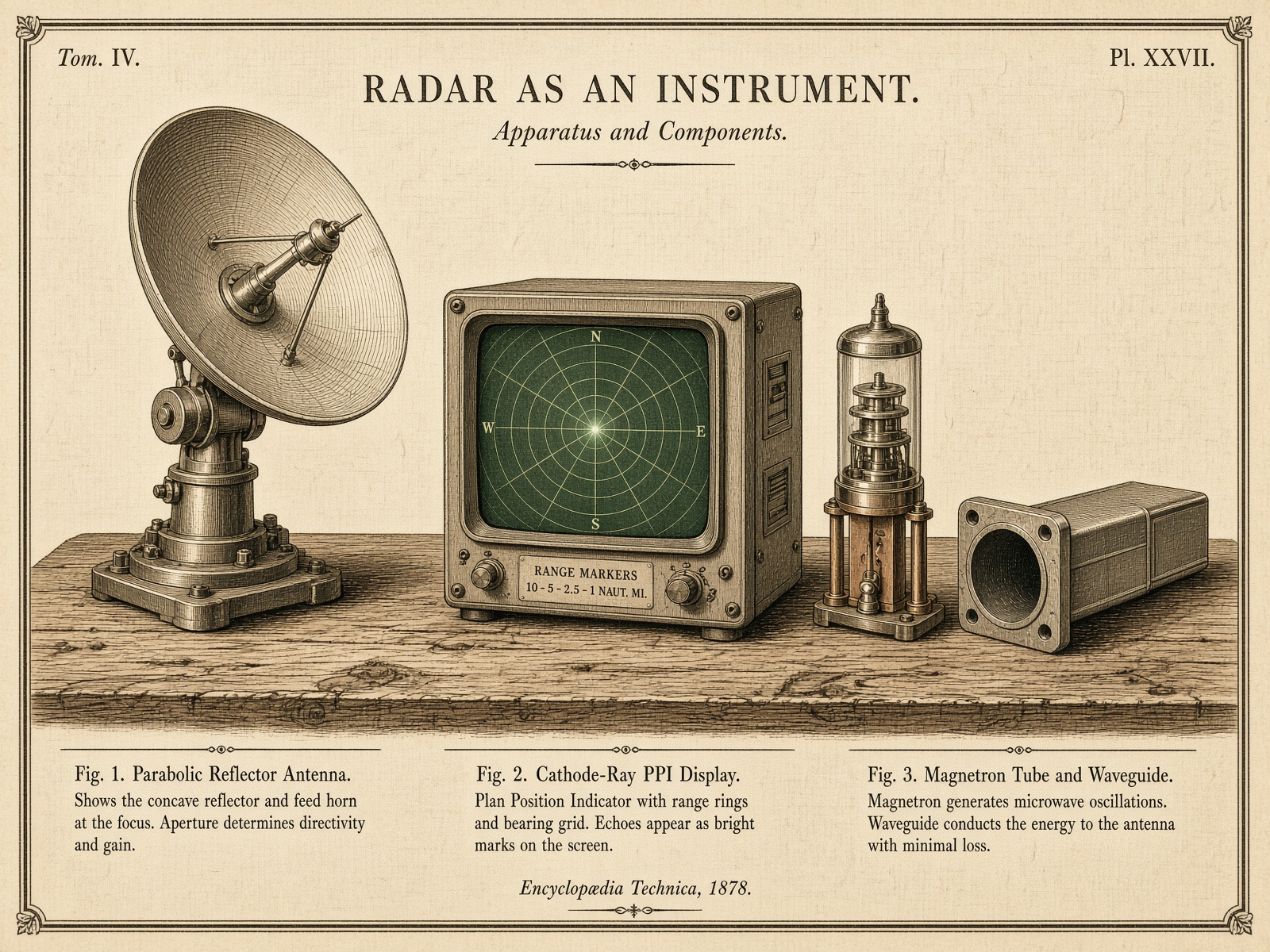
How the mechanism is arranged
How it works
- A transmitter fires a short, powerful pulse.
- A target reflects a tiny fraction back.
- The delay and direction of the echo locate the target.
Why it mattered
- Changed air war and then civil aviation.
- Pushed microwave electronics and screens.
- Gave weather a picture, not only a barometer.
What it unlocked
For further study
- Science Museum, radar. Chain Home equipment.
- Buderi, The Invention That Changed the World. Radar history.
Check
If an echo takes longer to return, is the target nearer or farther?