Communications · Vol. VI|Electronic television|1927 (Farnsworth); 1930s broadcasts
Electronic television
1927 (Farnsworth); 1930s broadcasts
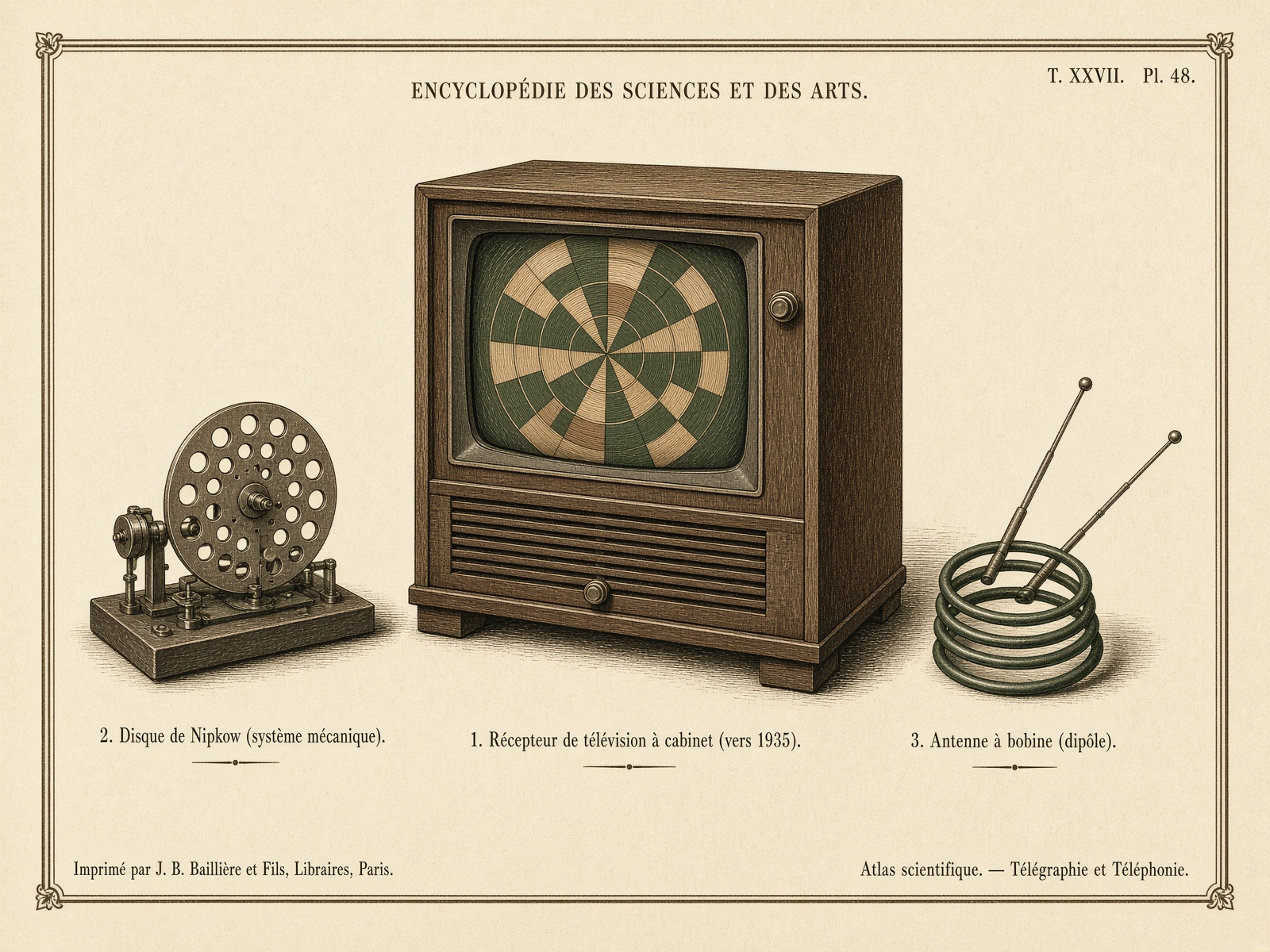
Mechanical scanning disks could send a crude picture. Electronic cameras and cathode-ray tubes made a picture people would sit for. Farnsworth transmitted a dollar sign in 1927. By the late 1930s, London and New York had broadcasts. Television is radio with a raster: the world as a sequence of lines, then as a shared evening.
Philo Farnsworth; Vladimir Zworykin; Baird (mechanical) · United States and Britain
How the mechanism is arranged
How it works
- A camera turns a scene into a stream of electrical samples, line by line.
- A transmitter sends that stream as a modulated wave.
- A receiver reconstructs brightness on a screen in the same order.
Why it mattered
- Made news and drama a domestic, simultaneous event.
- Created a mass visual public.
- Set expectations later inherited by the smartphone screen.
What it unlocked

For further study
- IEEE Milestones. Farnsworth and Zworykin.
- Abramson, The History of Television. Survey.
Check
What does a raster do to a picture?