Electronics · Vol. II|Electronic digital computer|1940s (Colossus, ENIAC, Manchester)
Electronic digital computer
1940s (Colossus, ENIAC, Manchester)
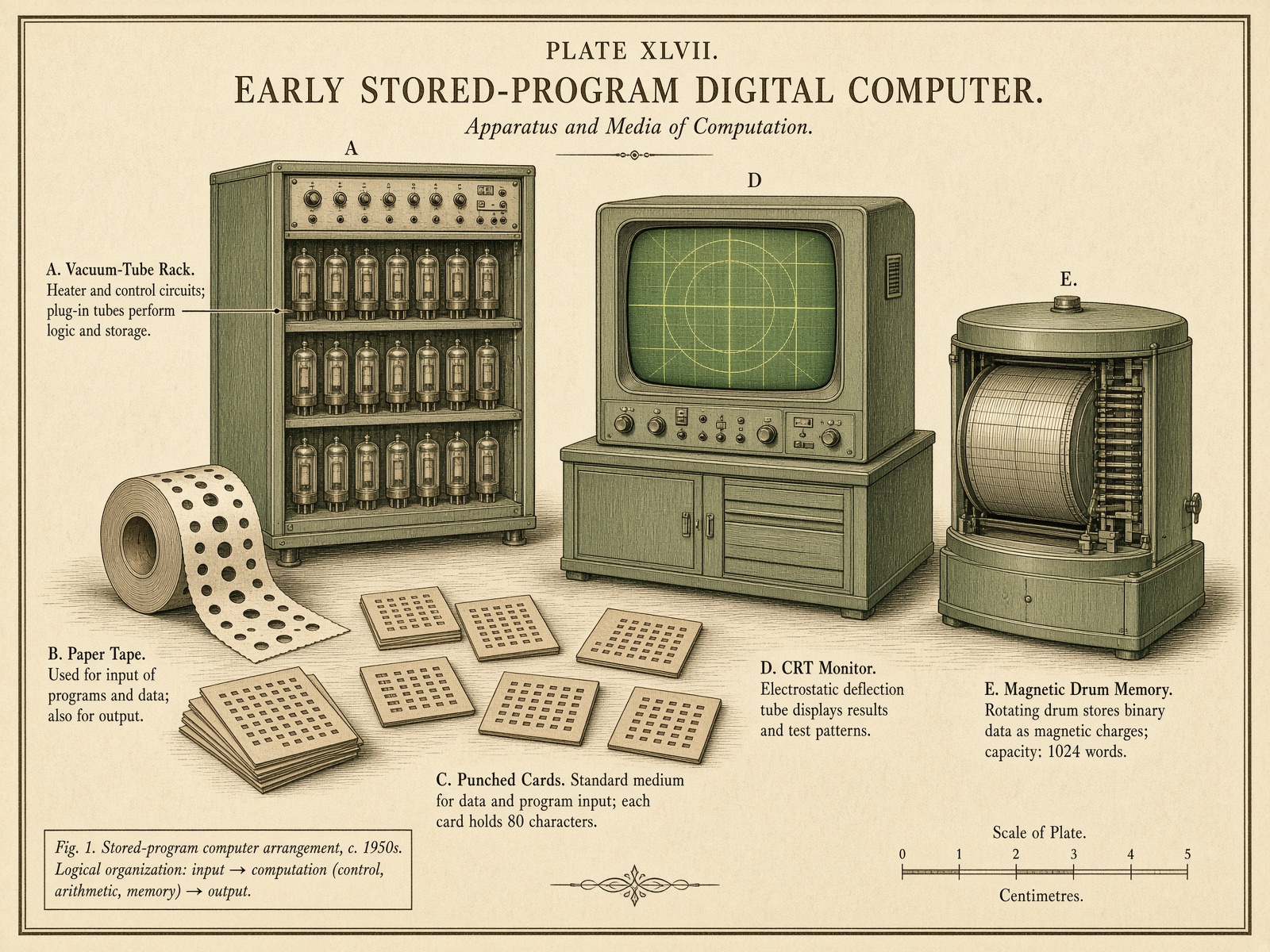
A computer is a machine that follows a stored program of arithmetic and logic. Wartime Colossus and ENIAC, then stored-program machines at Manchester and Cambridge, made the idea hardware. Tubes burned out. Memory was precious. Still, the pattern — fetch, decode, execute — is the one your laptop uses, only smaller and cooler.
Many teams (Turing, Flowers, Mauchly, Eckert, Williams, von Neumann…) · Britain and the United States
How the mechanism is arranged
How it works
- Represent numbers and instructions as electrical states (on/off).
- Store a program in memory; the control unit reads the next instruction.
- An arithmetic unit computes; results go back to memory or out to the world.
Why it mattered
- Moved calculation from rooms of clerks to a machine cycle.
- Made later software a distinct trade.
- Waited on the transistor to become personal.
Who turned the wheel
What it unlocked
For further study
- Computer History Museum. ENIAC and Manchester Baby.
- Ceruzzi, A History of Modern Computing. Survey.
Check
What does ‘stored program’ let you change without rewiring?