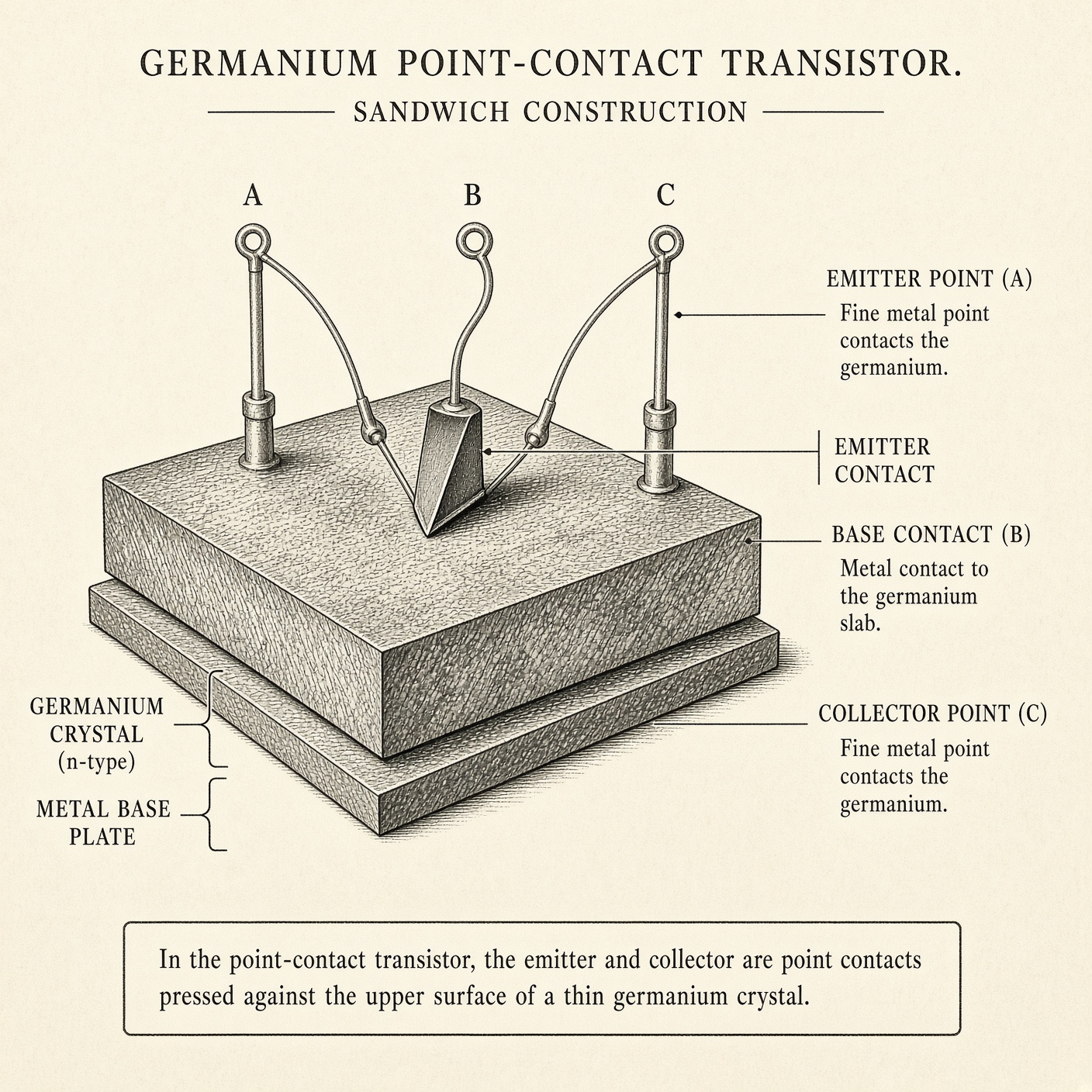
In December 1947 three researchers at Bell Labs built a small sandwich of germanium that could switch and amplify a signal without a glowing glass tube. That part — the transistor — is why radios, computers, and phones could shrink from furniture to a pocket. It needs no heater, fails less often, and can later be printed by the billion on one chip.
How it works
A semiconductor crystal is doped so regions are rich in electrons or in ‘holes’.
In a bipolar transistor, a small current into the base controls a larger current from collector to emitter.
The device amplifies or switches; unlike a tube, it does this cold, at low voltage.
Why it mattered
Beat the vacuum tube on size, heat, and reliability.
Made portable electronics and then computing personal.
Became the atom of the integrated circuit.
1904 (Fleming valve); 1906 (De Forest triode) · Electronics
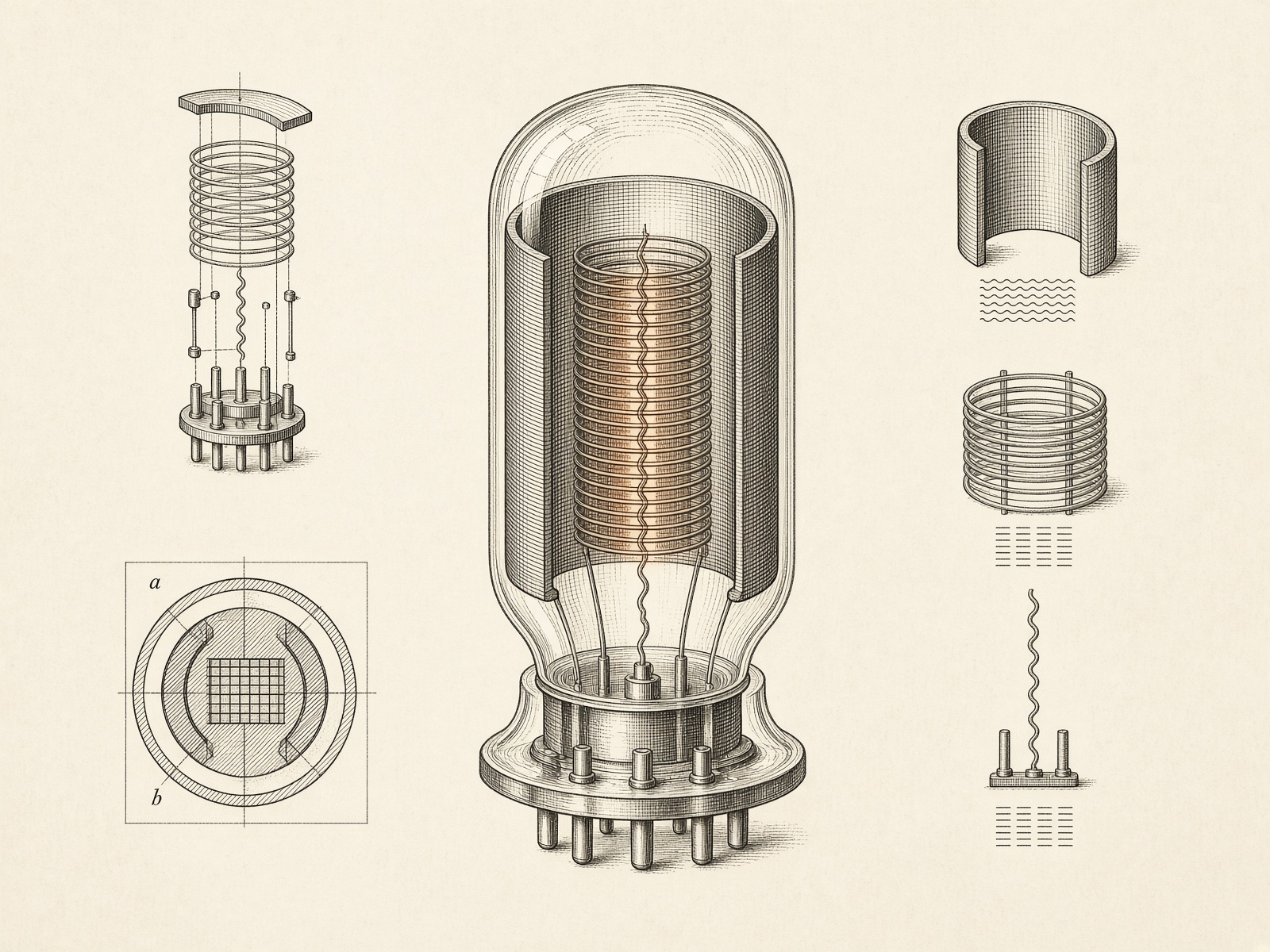
A heated filament in a vacuum emits electrons. Fleming used that as a one-way valve to detect radio. De Forest added a grid and made an amplifier: a small voltage on the grid controlling a larger current. For fifty years the tube was the transistor. Radios, radars, and the first digital computers are rooms full of glowing glass.
How it works
Heat a cathode so it emits electrons into a vacuum.
A positive plate collects them — current in one direction (diode).
A grid between them, charged slightly, throttles the flow (triode amplifier or switch).
Why it mattered
Made weak radio signals loud enough to hear.
Gave computing an electronic switch before semiconductors.
Set the performance bar the transistor had to beat: smaller, cooler, tougher.