Chemicals · Vol. IV|Penicillin production|1940s (industrial fermentation)
Penicillin production
1940s (industrial fermentation)
Fleming saw a mold kill bacteria in a dish in 1928. That was not yet a medicine. Oxford scientists purified enough to treat a person; wartime American labs learned to ferment penicillin in deep tanks on corn steep liquor. The landmark is not the lucky plate. It is the factory that made a drug a public good.
Fleming (1928 observation); Florey, Chain; U.S. labs for scale-up · Britain and the United States
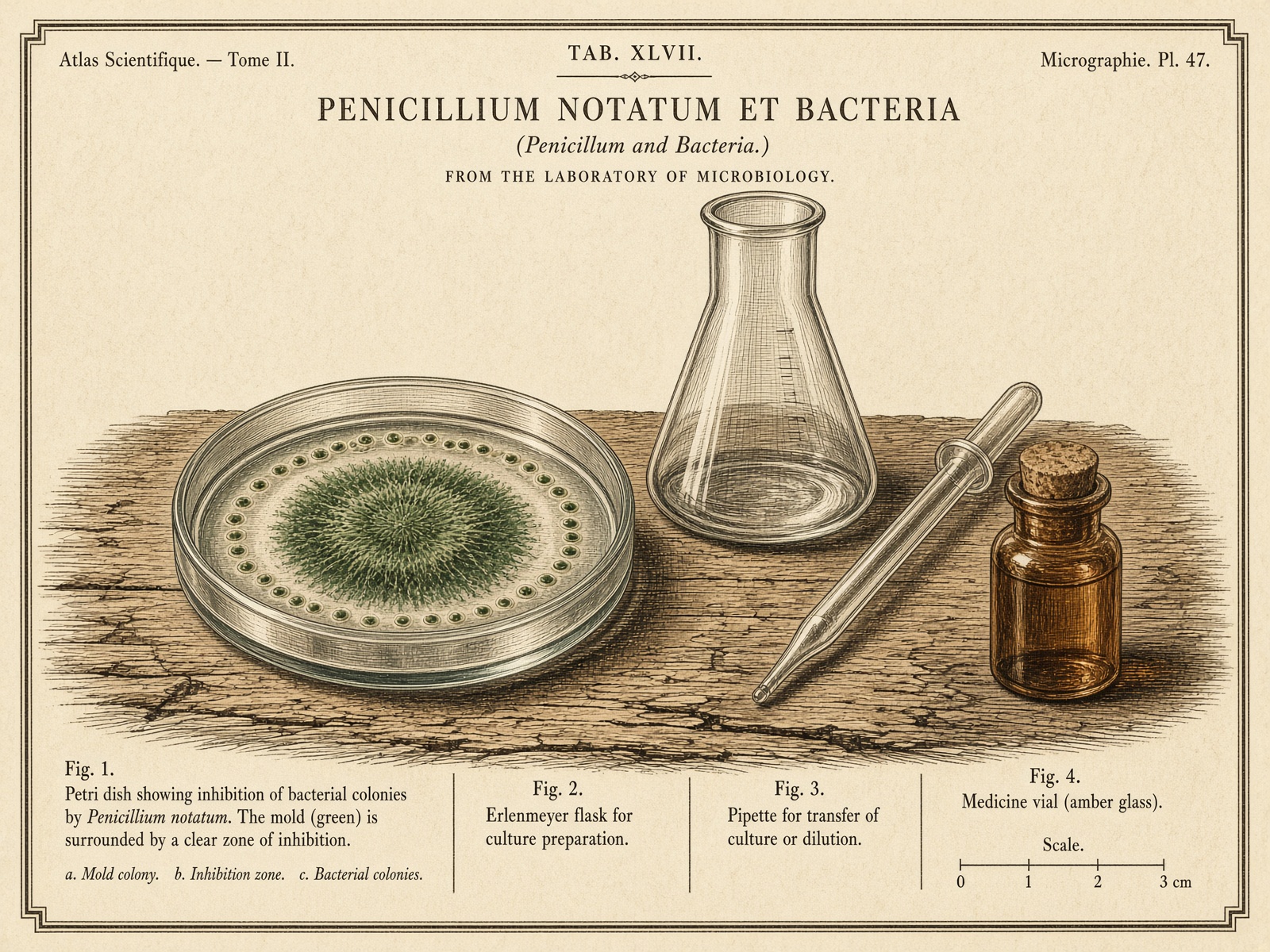
How the mechanism is arranged
How it works
- Grow Penicillium in aerated tanks with a carefully chosen feed.
- Extract and purify the antibiotic from the broth.
- Dose so that bacteria die faster than they evolve resistance — a race still on.
Why it mattered
- Turned many once-fatal infections into treatable ones.
- Created the template of industrial biotechnology.
- Taught a warning: overuse selects for resistance.
Who turned the wheel
What it unlocked
For further study
- Science Museum, penicillin. Production artifacts.
- Bud, Penicillin: Triumph and Tragedy. History and resistance.
Check
Why was Fleming’s dish not yet a technology of public health?