Electronics · Vol. II|Electric light|1878–1879 (Swan and Edison practical lamps)
Electric light
1878–1879 (Swan and Edison practical lamps)
A filament in a vacuum glows when current heats it, without burning up at once. Swan and Edison, in parallel, made lamps that lasted long enough to sell, then built generators and wiring to feed them. Gaslight had already extended the day. Electric light made it cleaner, safer in some uses, and eventually cheaper. Night became a designed environment.
Joseph Swan; Thomas Edison; many prior experimenters · Britain and the United States
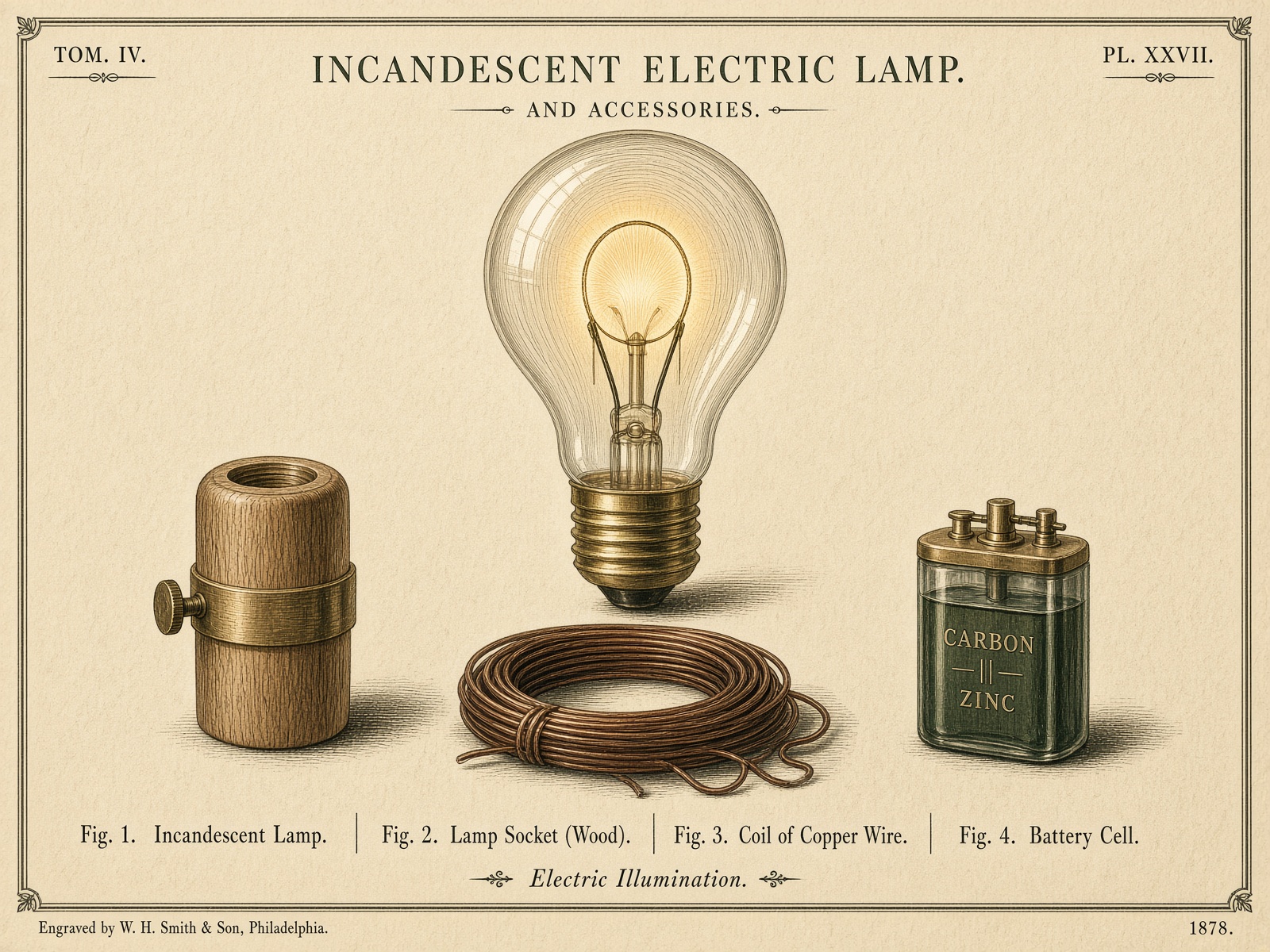
How the mechanism is arranged
How it works
- Pass current through a high-resistance filament in a glass bulb with little oxygen.
- The filament heats to incandescence and radiates light.
- A parallel circuit of lamps shares a dynamo’s current.
Why it mattered
- Created demand for central generation.
- Changed factory shifts, streets, and domestic evening.
- Made electronics a consumer product, not only a lab.
Who turned the wheel
What it unlocked
For further study
- Science Museum, Swan lamp. British priority.
- IEEE History Center. Edison system.
Check
Why must the bulb contain so little oxygen?