Communications · Vol. VI|Telephone|1876
Telephone
1876
A diaphragm, a magnet, a current that wiggles as a voice wiggles air. Bell’s 1876 patent is the famous one; others were close. The telephone did not invent long-distance speech. It invented a network of switching so any two subscribers could be a circuit. The switchboard, later the automatic exchange, is the real machine.
Alexander Graham Bell; competing claims by Meucci, Gray, Reis · United States (patent battle); many labs
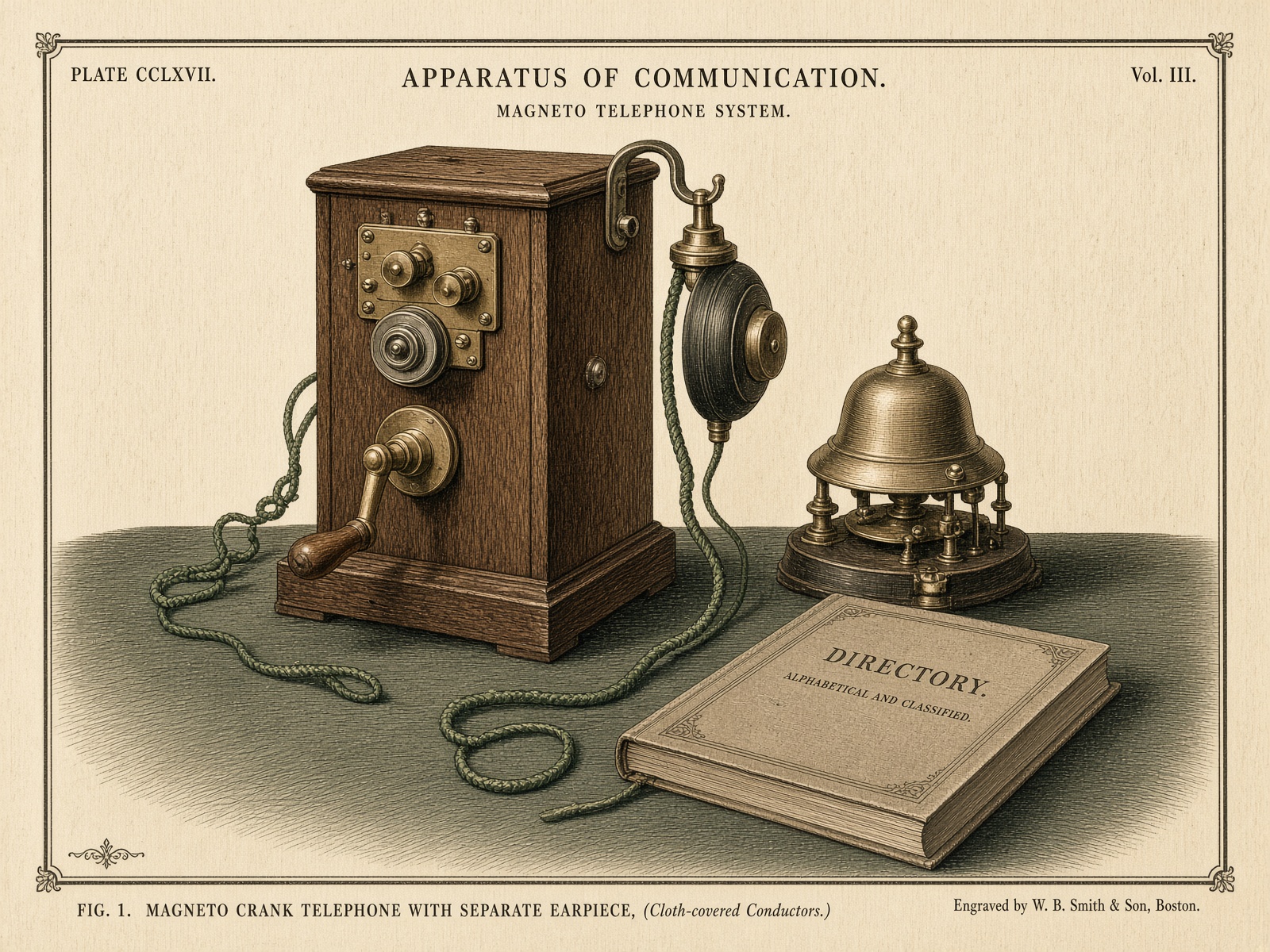
How the mechanism is arranged
How it works
- Sound moves a diaphragm attached to a transmitter that varies a current.
- The varying current travels a wire.
- A receiver turns the current back into motion of another diaphragm — sound again.
Why it mattered
- Made conversation, not only code, a telecommunications product.
- Built switching as an industry.
- Prepared the later logic of the internet: connect any pair.
What it unlocked
For further study
- Library of Congress, Bell papers. Patent and notebooks.
- Bruce, Bell. Biography and priority debate.
Check
Why is a switchboard as important as a handset?