Communications · Vol. VI|Radio|1895–1906
Radio
1895–1906
A spark, an antenna, a coherer or later a tube: wireless telegraphy threw Morse across a gap with no wire between. Marconi’s demonstrations made a business. Fessenden’s 1906 voice transmission showed the same ether could carry speech. Radio made a broadcast possible — one sender, many listeners — a shape of public life the telegraph never had.
Marconi, Popov, Tesla, and many others; Fessenden (voice) · Europe and the Atlantic
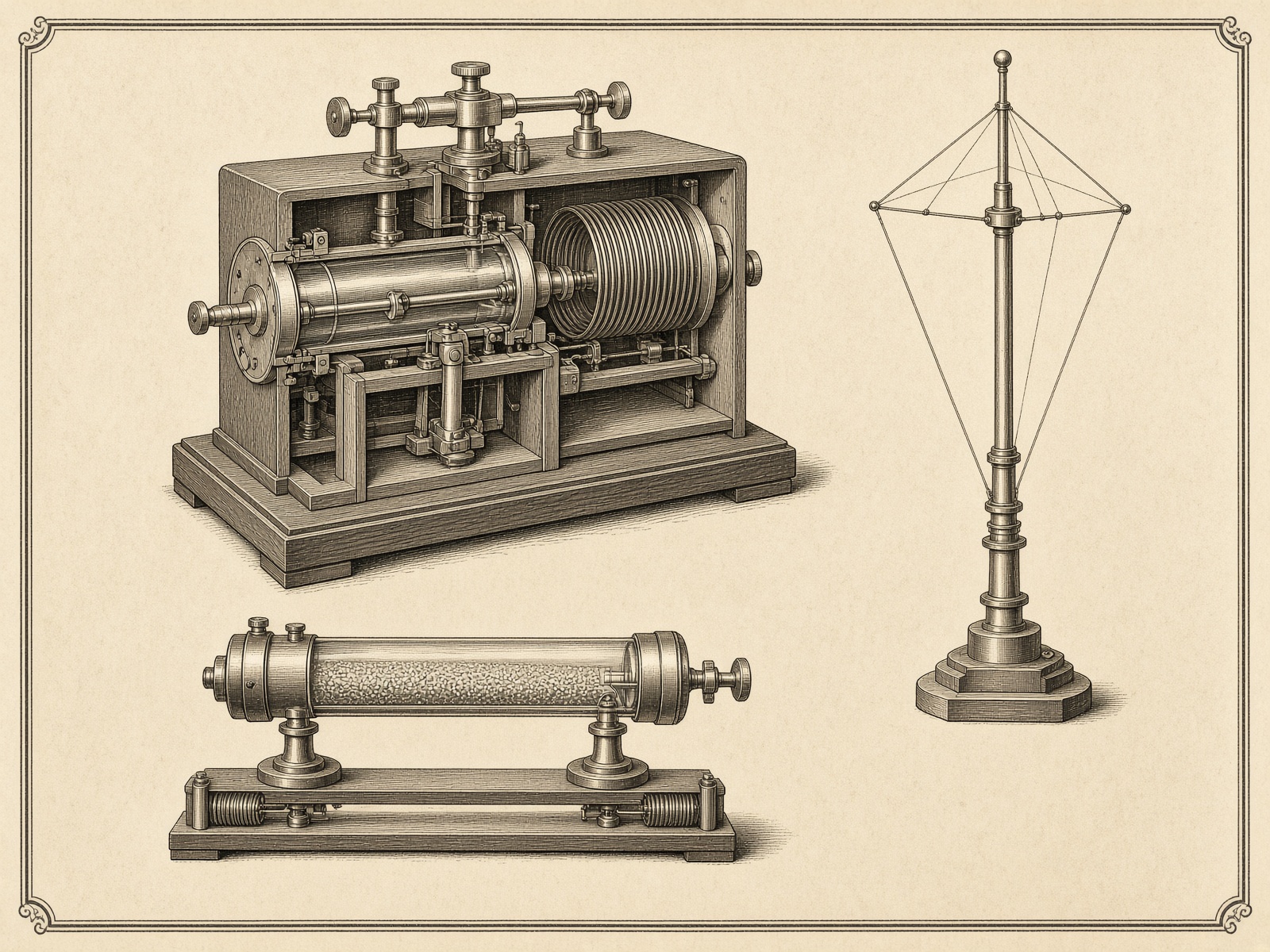
How the mechanism is arranged
How it works
- An oscillating current in an antenna launches electromagnetic waves.
- A distant antenna intercepts a whisper of that energy.
- A detector turns the wave back into clicks or audio.
Why it mattered
- Reached ships and places no cable had been laid.
- Invented broadcasting as a social form.
- Filled the spectrum, which then had to be governed.
Who turned the wheel
What it unlocked
For further study
- IEEE Milestones. Wireless telegraphy.
- Aitken, The Continuous Wave. From spark to voice.
Check
How does a broadcast differ from a telegraph in who can listen?