Transportation · Vol. VII|Public railway|1825 (Stockton & Darlington)
Public railway
1825 (Stockton & Darlington)
Flanged wheels on iron rails cut friction so a steam locomotive can haul what a road wagon cannot. The Stockton and Darlington line of 1825, then the Liverpool and Manchester of 1830, showed that passengers and freight would come. Rails standardized time, suburbs, and war. A railway is a machine the size of a landscape.
George Stephenson and contemporaries · Britain
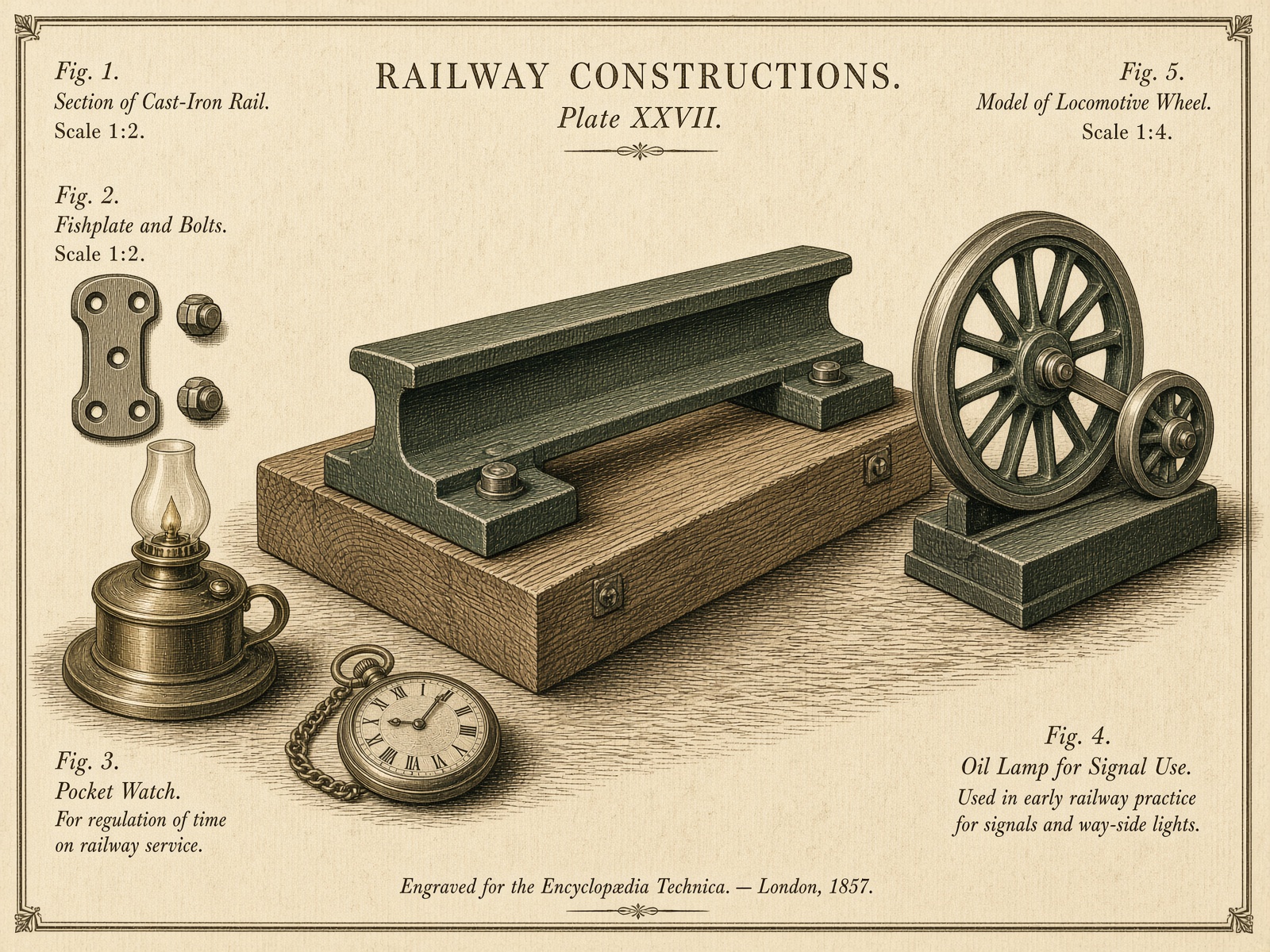
How the mechanism is arranged
How it works
- Lay a pair of rails to a gauge; wheels stay on by flanges.
- A locomotive converts steam (later diesel or electricity) into pull.
- Signaling keeps trains from occupying the same block.
Why it mattered
- Collapsed inland transport costs for coal, grain, and people.
- Forced national time zones so timetables would match.
- Became the skeleton of industrial nations.
Who turned the wheel
What it unlocked
For further study
- National Railway Museum, York. Stephenson locomotives.
- Schivelbusch, The Railway Journey. Social effects.
Check
Why do rails let a locomotive pull more than a road engine of the same power?