Semiconductors · Vol. V|Moore’s observation|1965
Moore’s observation
1965
In 1965 Gordon Moore noted that the number of components on a chip had doubled on a short cycle and guessed it might continue. It was a forecast, a coordinating myth, and a business plan — not a law of nature. For decades the industry used it as a schedule: shrink, yield, sell. When physics got hard, the doubling slowed. Treat it as history, not destiny.
Gordon Moore (as observer, not a physical law) · United States
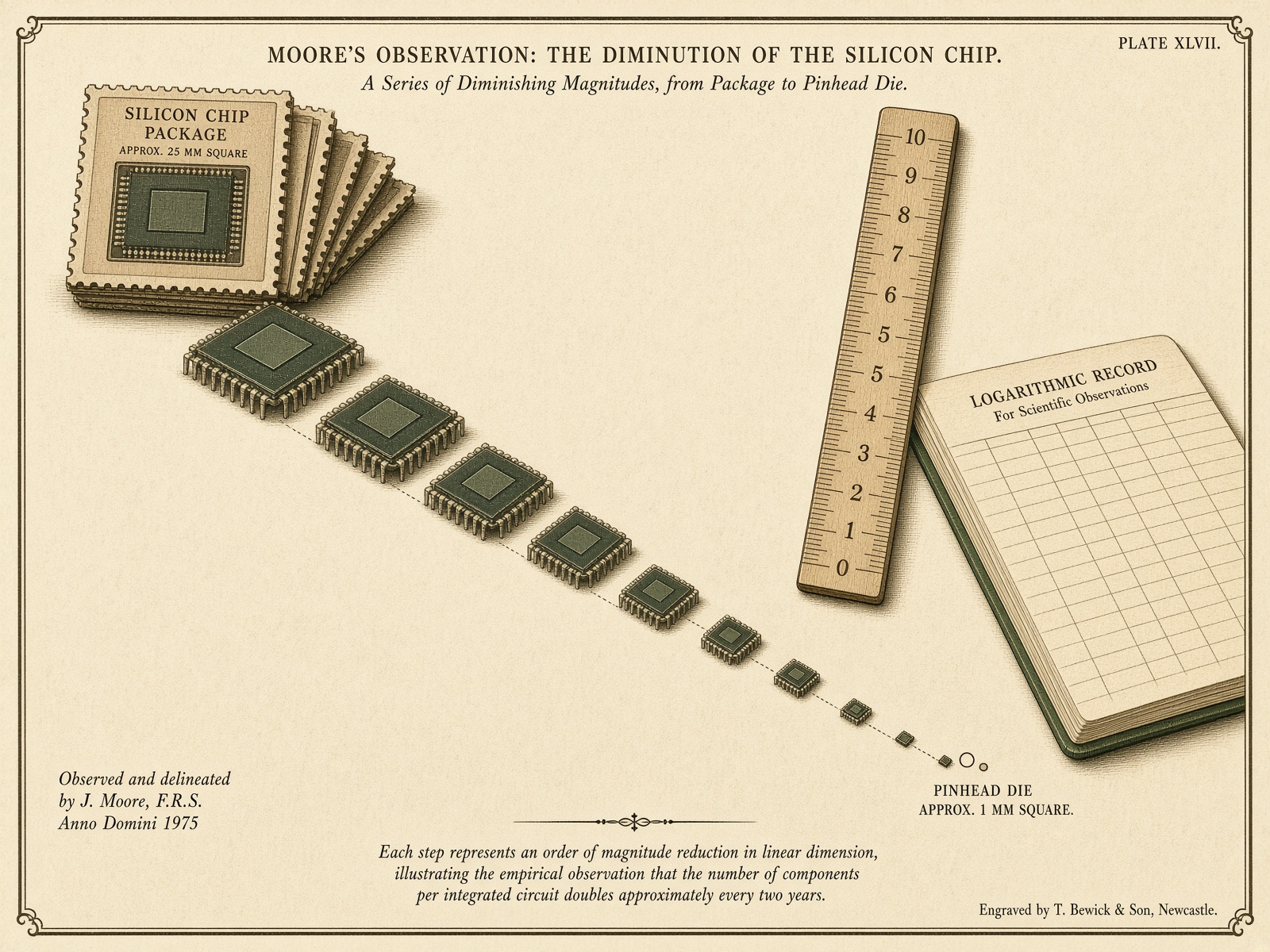
How the mechanism is arranged
How it works
- Shrink transistor features with better lithography and device design.
- Raise yield so more chips per wafer are good.
- Sell the extra transistors as new products, funding the next shrink.
Why it mattered
- Gave electronics a shared roadmap.
- Made exponential language ordinary in a factory.
- Hid, for a time, that exponential curves end.
What it unlocked
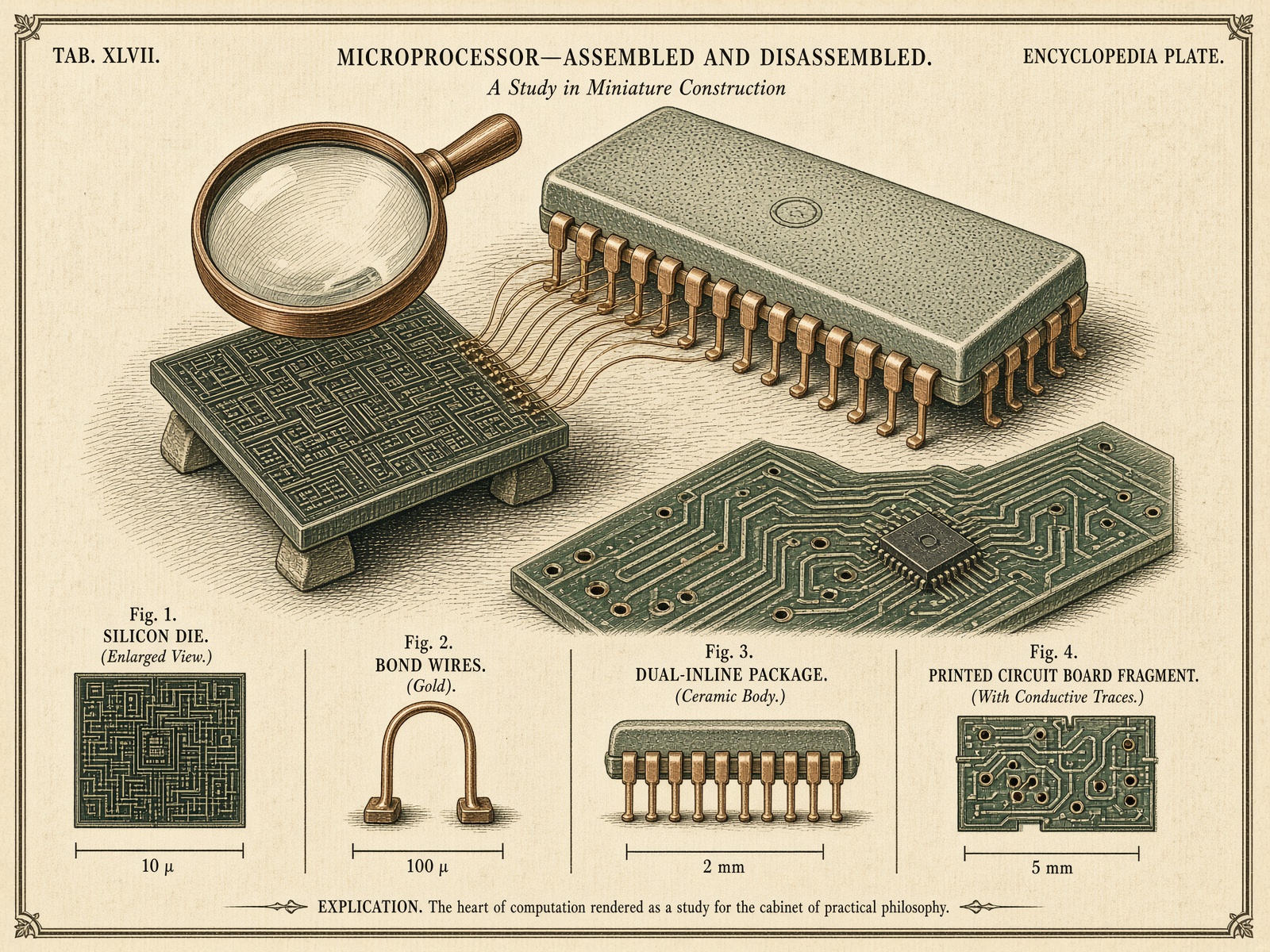

For further study
- Moore, Electronics magazine, 1965. Original article.
- Mack, ‘The Multiple Lives of Moore’s Law’. Critical history.
Check
Why is Moore’s observation not a law of physics?